

#03: Rizzo
Okay girls. Let’s go get ‘em

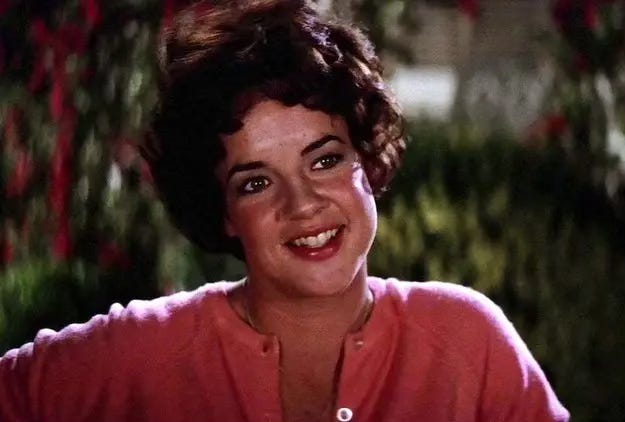
As a girl growing up in the 1970s and 80s, there were worse things you could do than look to Rizzo as a role model. She was strong, determined and in control of her own destiny. She did what she wanted, when she wanted, without apology – and had no time for double standards.
Even as a child, I knew that Rizzo had all the best lines, and all the best outfits. In fact, I’m pretty sure she’s the reason I’ve always loved black and pink, red and pink, dark sunglasses and polka dots (Oh, that Dance-Off dress).
Grease was the first film I saw at the cinema. I was five years-old so most of it went way over my head. What exactly was Kenickie’s ‘25 cent insurance policy’? Why did Rizzo feel like a ‘defective typewriter’? What was a ‘hickey’? None of that mattered because I loved the songs, and was a fully paid up member of the John Travolta fanclub (yes, it was a real thing, and I had the membership card and fan magazines to prove it) – but, as I got a bit older, Rizzo became the character who intrigued me the most.
Obviously, little girls were supposed to love Sandy. She was, after all, the face on the poster: sweet, blonde and beautiful. But, in truth, I felt a bit sorry for her. She only became interesting at the end, when she was sewn into a pair of spandex trousers, got a perm and started smoking – even then, it was all a bit awkward and embarrassing.
Rizzo was a far more radical proposition. She gave the impression that being an adult (or, at least a 33 year-old perpetual teenager) could be a lot of fun. She was bold, funny – and sometimes terrifying. The T-Birds – who cheerfully sang about whether Sandy had ‘put up a fight’ – knew better than to mess with Rizzo. She climbed out of the window at a sleepover to “get my kicks while I’m still young enough to get ‘em”, threw Kenickie’s leering friends out of his car, and felt no obligation to play nice or keep men happy. When Kenickie told her that she had “the personality of a wet mop” and wondered out loud if he should break up with her, she chucked a strawberry milkshake at him and stormed off. She was uncensored and uncompromising – even now, over 45 years later, we don’t see enough women like Rizzo on screen.
So even though Grease was ostensibly all about Sandy, Betty Rizzo was very obviously the Strong Female Lead.
In a recent interview with The Times, Stockard Channing, who played Rizzo, says that it took time for her to feel proud of her role in Grease. She explains: “I’ve gone through a lot of changes about that experience… I gave [Grease] my all, and I’m proud of the performance and proud of the character. But at the time, it was not taken at all seriously. The money that it was making was resented. I was resented.” Now, at the age of 80, she says: “I realised with time, how it’s affected generations, especially of women and even some men.”
Watching Grease today, I’m struck by how subversive Rizzo was – and I’m sure that had plenty to do with Channing herself who, at 33, was several years older than the rest of the cast.
“It’s funny, because, when we made the film, she was the boss and we were all her little ponies,” says Didi Conn, who played Frenchie. “She always kept that distance. She had that in the film, which was right for the character, but it was also who she is, a little bit,” she told The Sun. “She’s kind of stayed in her own world.”
Unlike Sandy, Rizzo would never change herself for a man. She drinks, smokes and has sex – and is prepared to deal with the consequences. Crucially, when she has a pregnancy scare (which happily resolves itself in time for the film’s all-singing-all-dancing finale), the audience sees that even though she’s scared, she can handle whatever life throws at her.
It’s obvious from the start that Rizzo is a rebel – she dresses in black, wears dark sunglasses and has short hair. It’s the ultimate bad girl uniform. Yes, she can be rude. She’s mean to Sandy, and deliberately causes trouble with Danny. She lashes out at Kenickie whenever she feels jealous or vulnerable, telling him that, even if she is pregnant, the baby isn’t his. Then she deliberately sets out to hurt him by going to the dance with his rival ‘Crater-Face’, the leader of The Scorpions.
But, by the end of the film, Rizzo shows her softer side – and her self awareness. In There are Worse Things I Could Do she sings:
“I could hurt someone like me
Out of spite or jealousy.
I don’t steal and I don’t lie,
But I can feel and I can cry,
A fact I’ll bet you never knew.
But to cry in front of you,
That’s the worst thing I could do."
I don’t think it’s an exaggeration to say that Rizzo showed a generation of girls how to stand up for themselves. She’s celluloid proof that girls and women can be more than one thing: strong and vulnerable, brave and scared, fierce and loving. She’s a loyal friend to the Pink Ladies, and ultimately to Sandy too, but she can also be mean and vindictive. She made being bad look so very good.
But while Rizzo will be 18 forever, Stockard Channing has lived a lot of life since making Grease. She famously starred in the West Wing, and several years ago she upped sticks and moved to London, where she’s now starring in a West End production of Elektra. “I consciously try to be in the moment, because there’s a lot of things conspiring to take you away – friends of a similar age who are still enmeshed in the past,” she told The Times. “I think it’s just incredibly important to update the file – fluff the pillows, change the sheets, you know.”
We have a feeling Rizzo would approve of that attitude – as long as the sheets were pink satin, and the pillows were heart-shaped.